
The Boy on the Bicycle
An ordinary summer afternoon forced me to confront an inheritance I didn't know I was carrying.

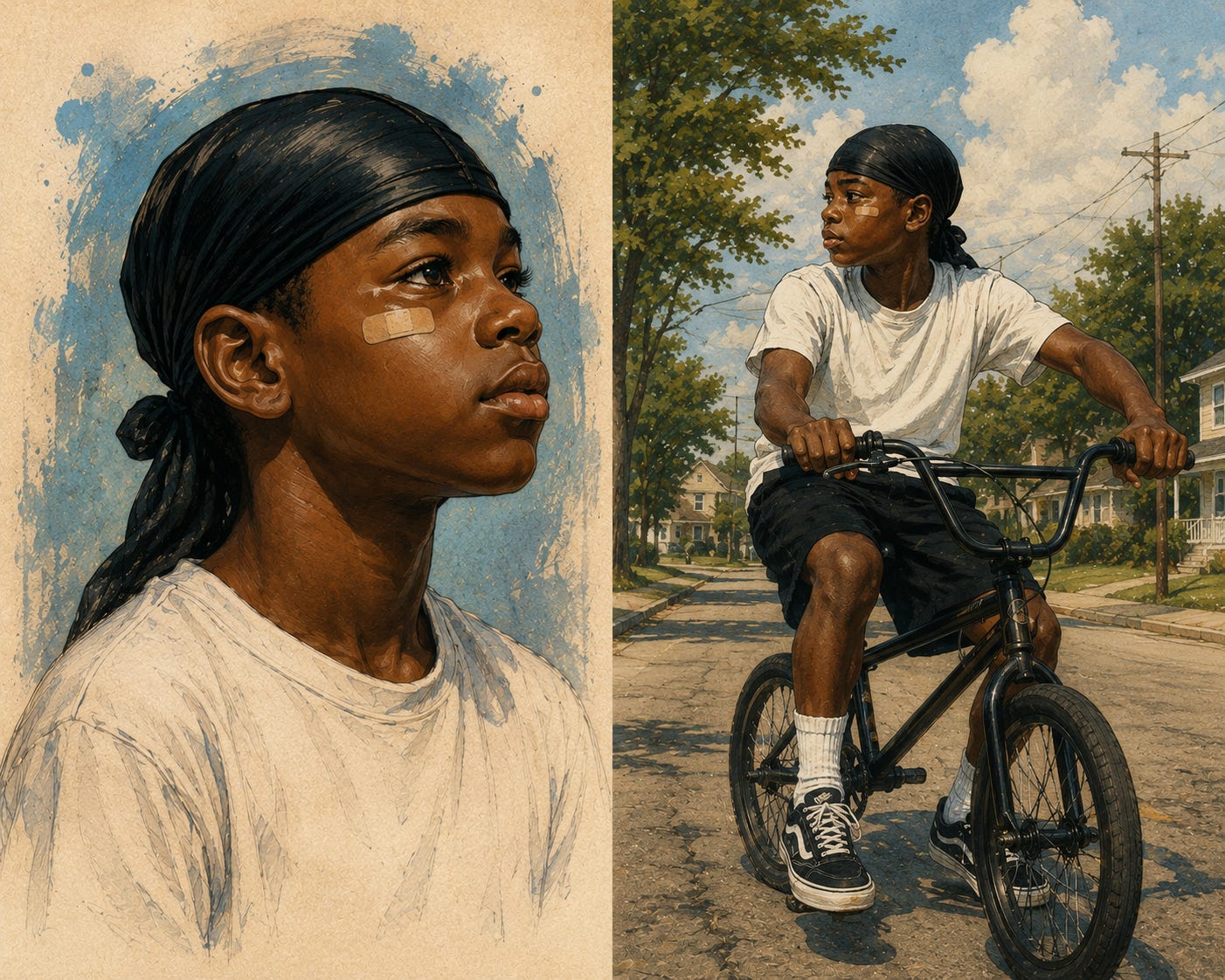
A boy, maybe 11, darts across the intersection. At the curb he pops a small wheelie, not for an audience, it seems, but because boys have been lifting bicycle tires off sidewalks for as long as bicycles have existed. He lands softly, pedals away from my windshield and outside my periphery.
That image seized my attention. There was something beautifully ordinary about it.
My insides fluttered gleefully at the sight of America’s youth playing outdoors, which has somehow devolved into a relic of yesteryear. A child. A bicycle. Summer.
But as he crossed in front of my car, my eyes catalogued him almost absentmindedly, the way you inventory a passing stranger without realizing you’re doing it.
Sneakers. Basketball shorts. An old Huffy bike. White t-shirt. Bandage under his left eye.
Then…
The durag. Uh oh.
A frigid tinge disturbed the warm nostalgia that had kindled inside me. And a new effigy was chiseled in my imagination.
The flap of his durag drifting behind his neck, catching just enough air to flutter but never enough to levitate. It rose and fell with every push of the pedals, like a kite searching for wind.
I knew exactly what my first thought was. I hated it.
Why is he wearing a durag out here?
No, I’m not being honest. My unfiltered thought was: Why is this Black boy wearing this thuggish durag in this predominantly white suburb?
It wasn’t the kind of thought you say aloud. It wasn’t even the kind of thought I believed, I think. But it arrived anyway, fully formed, before my better judgment had a chance to intercept it.
I imagined the white families who lived in this quiet suburban neighborhood.
I imagined them seeing him. Then, almost without realizing it, I imagined them seeing all of us.
Somehow, that young boy had become a representation for all of Black America. I hated myself for it.
The rest of the afternoon, I couldn’t stop replaying those few seconds in my head.
Why was I embarrassed that a Black boy was wearing a durag?
Why did some part of me instinctively wish he had been wearing a polo shirt or a collared button-down instead?
Why, in that fleeting moment, did I want him to look more acceptable? More harmless.
More... reassuring.
The questions unsettled me because I knew they weren’t really about him. They were about me.
Or, more accurately, they were about something I had inherited. Some old-school, lingering remnants of Jim Crow or slavery or some bullshit.
But another question kept bothering me.
Who decided a durag was “thuggish” in the first place? Who made themselves the Secretary of Black Fashion? Somewhere along the way, a hair accessory became a character reference. A piece of fabric used to protect hair somehow got promoted to evidence.
Damn, a brother can’t even lay down his 360 waves without folks writing a whole psychological profile.
I’d never considered how deeply those messages had settled inside me until I watched that boy ride by. A few days later, I found myself thinking about W.E.B. Du Bois, the pioneering Black scholar, historian and civil rights activist whose classic, The Souls of Black Folk, gave language to an experience generations of Black Americans had long lived but struggled to describe.
Before I fetched the book from my bookshelf, I realized something that made me uncomfortable.
I’d been living inside Du Bois’ double consciousness for years without realizing how deeply it had shaped me.
In The Souls of Black Folk, Du Bois describes double consciousness as the “peculiar sensation” of “always looking at one’s self through the eyes of others.”
For me, those “others” had almost always been an imagined White America. Looking back, I can see it everywhere.
The excitement of buying my first polo shirt. The pride I felt slipping into a pair of khakis and loafers for the first time. Peacocking around like a chocolate Abercrombie & Fitch model. At the time, I thought I was discovering my style. Or perhaps I thought it represented money, or status, or some strange elevation and separation from the ‘niggas’ in the hood still wearing baggy jeans and Jordans.
Now, when I think back to the boy on the bicycle. Without realizing it, I had judged him by the same invisible standards I’d spent years applying to myself.
He wasn’t violating my standards. He was violating standards I had unconsciously borrowed from an imagined White America.
That’s when Du Bois clicked for me.
The boy wasn’t really the subject of my judgment.
I was.
He was simply the younger version of myself.
On that summer afternoon, the boy rode away. The gaze remained.